Instrument
About VIIRS
The Visible Infrared Imaging Radiometer Suite (VIIRS) is a whiskbroom scanning radiometer imaging Earth’s land, atmosphere, cryosphere and ocean. It continues the long-term records of AVHRR and MODIS on the JPSS series.
Platforms
VIIRS flies on three polar-orbiting satellites in a sun-synchronous 1:30 pm ascending-node orbit:
- Suomi NPP (S-NPP) — NASA / NOAA, launched 2011-10-28
- NOAA-20 (JPSS-1) — NOAA JPSS, launched 2017-11-18
- NOAA-21 (JPSS-2) — NOAA JPSS, launched 2022-11-10
JPSS-3 and JPSS-4 are planned follow-ons that will extend the record.
Sensor characteristics
- 22 spectral bands from ~0.4 µm to ~12.5 µm — 16 moderate-resolution (M) bands at 750 m, 5 imaging (I) bands at 375 m, plus the Day / Night Band (DNB).
- Swath width ~3060 km — full global coverage twice per day (day + night) per satellite.
- Spatial resolution 375 m (I-bands) or 750 m (M-bands, DNB) at nadir.
- Radiometric quality 12-bit, with on-board solar-diffuser and blackbody calibration.
The flood product
Processed near-real-time at the CIMSS (UW-Madison SSEC), funded by NOAA / NESDIS and the JPSS Program Office. Three generations:
- Flood Detection Map (V1.0) — daytime-only 375 m flood extent.
- Flood Water Fraction — per-pixel 0–100 % fraction, not just binary extent.
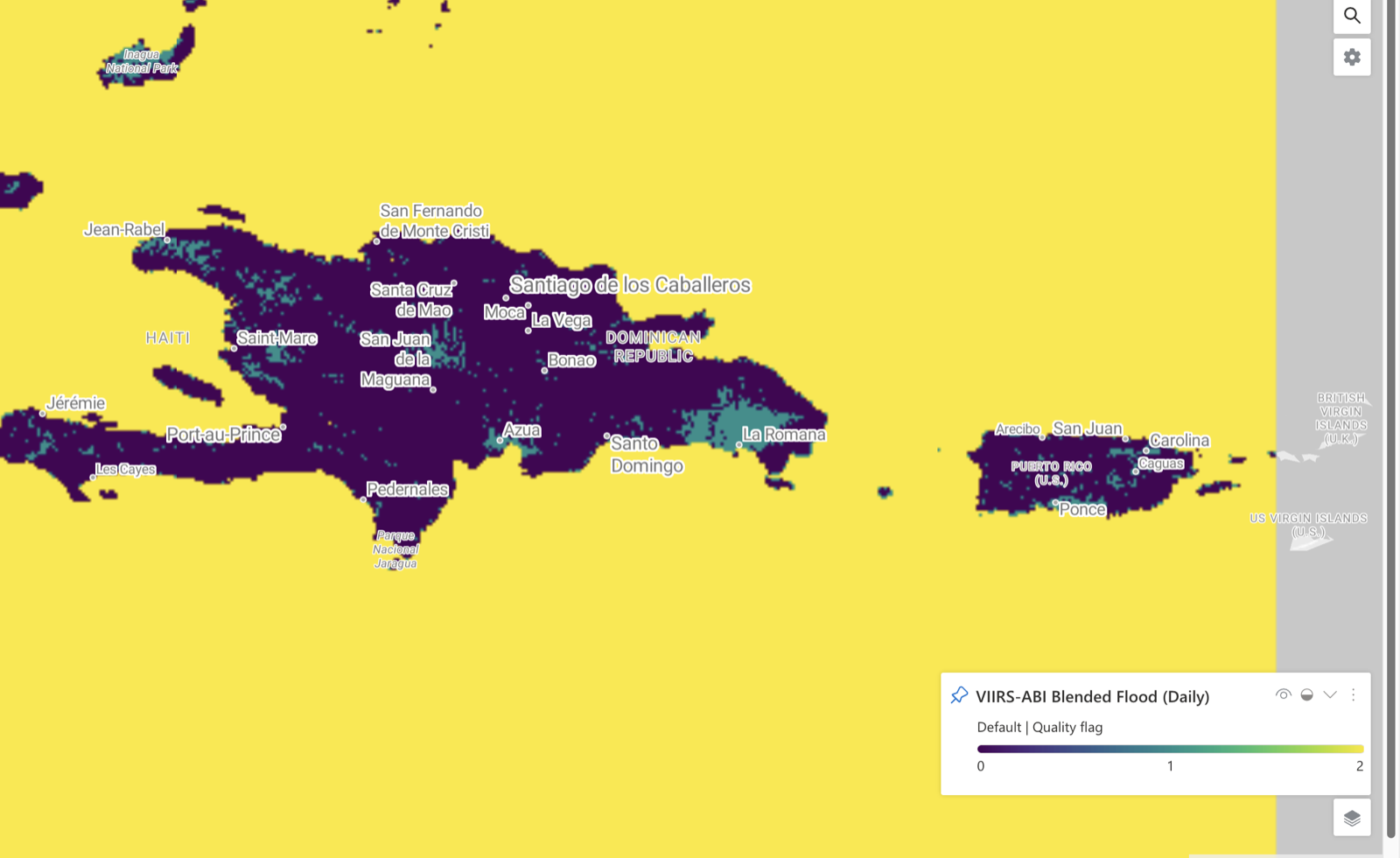
- VIIRS-ABI Blended Flood — polar VIIRS (high-res, twice daily) blended with geostationary ABI on GOES-R (frequent updates, cloud-gap fill). The MVP is built around this product.